Why a Scale?
A liquid's volume can be determined from its mass if its density is known. Beer is mostly water, and water has one of the most precisely characterized densities in science: 1 gram per milliliter at standard conditions. Beer's density deviates only slightly—typically between 1.005 and 1.020 g/mL depending on residual sugar and alcohol content—and that deviation is predictable from the beer's final gravity. Weigh the beer, divide by its density, and you have its volume.
This is not a workaround. In analytical chemistry, gravimetric measurement—determining quantity by mass—is the gold standard for liquid volume. A properly calibrated scale is more accurate, more precise, and more reliable than reading a meniscus against graduation marks on a cylinder or beaker. Graduated glassware is subject to parallax error, manufacturing tolerance in the markings, temperature-dependent expansion of the vessel, and the judgment of the person reading it. A digital scale reports a number. There is no interpretation, no angle of viewing, no judgment call. The precision of a benchtop digital balance is 10 to 100 times better than volumetric glassware[4]. This is why NIST itself calibrates volumetric glassware by weighing the water it contains and dividing by density—the gravimetric method is the standard against which volumetric instruments are checked, not the other way around[5][6].
It is also the only practical method for fieldwork. A jeweler's scale fits in a pocket, reads to 0.01 oz, and delivers a measurement in seconds without altering or disturbing the pour. It is discreet—no pouring, no mess, no conspicuous laboratory equipment on the bar. And unlike a graduated cylinder, which must be sized to the volume being measured, the same scale measures a 4 oz taster and a 20 oz imperial pint with equal precision.
Testing the Scale against Standards
A jeweler's scale with 0.01 oz resolution was used to measure beer serving weights. Scale accuracy was verified using a 16 fl oz (473 mL) pint can of macrobrewery beer (e.g., Narragansett Ale, final gravity [FG] = 1.011). The expected beer mass was calculated as 16 fl oz × 1.011 × 1.0432 oz/fl oz = 16.87 oz. The factor 1.0432 is the ratio of the mass of one US fluid ounce of water (29.5735 g) to one avoirdupois ounce (28.3495 g)—a necessary correction because fluid ounces measure volume while avoirdupois ounces measure mass, and the two are not equivalent[1].
The full can was weighed and photographed for simple documentation. Its contents were then consumed, and the empty can shaken vigorously to remove residual liquid, followed by reweighing and photographing for documentation. The beer mass was determined by subtracting the empty can weight from the full can weight. Measurements within 2% (±0.34 oz) of 16.87 oz were deemed acceptable; discrepant results prompted retesting with a second can or substitution with an alternative scale. Verified scales proceeded to data collection.
Measuring a Pour at the Bar
Beer pours were measured at bars using a portable jeweler's scale (0.01 oz resolution, kept out of view). Upon seating at the bar stool, a pint (or specified volume) serving of beer was ordered. Upon delivery, if the pour appeared visually short, the bartender was asked for reassurance that it was a normal pour or if it could be topped off, requesting a full pour without debate.
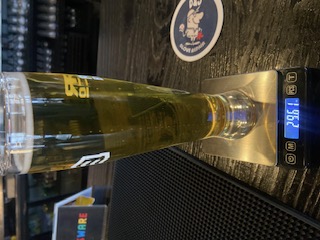
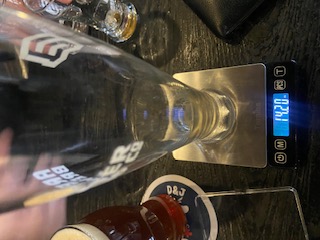
Before consuming or spilling any beer, the scale was retrieved from storage, set up, tared to zero in ounces, and the vessel with the full pour placed upon it for immediate weighing. The beer on the scale was photographed for documentation, capturing the vessel shape, beer volume/height, and scale reading as the focal point. The beer was then fully consumed to the last drop, after which the empty vessel was reweighed using the identical setup and photographed for documentation. The beer mass was calculated by subtracting the empty vessel weight from the full pour weight. A single pour sufficed for conclusion, as the bartender was afforded full opportunity for an honest, maximum-volume pour; deviations exceeding 2% from expected mass prompted sample exclusion.
 A
A
 B
B
Figure 1. Before and after consumption documentation shows the full glass (A) and the emptied glass (B) weighed on the scale. Note how the scale reading is in focus.
Calculating the Volume of a Pour
Beer volume was calculated from the measured mass (full vessel weight minus empty vessel weight, in oz) using the final gravity (FG) and expected mass per 16 fl oz. If the FG was published (expressed as 1.0XX, relative to water at 1.000), it was used directly. Absent published FG, the density of the finished beer was approximated as FG ≈ 1 + (ABV / 500), where ABV is the alcohol by volume percentage. This yields, for example: 4.2% ABV → FG 1.008; 5.5% ABV → 1.011; 6.9% ABV → 1.014. The approximation reflects the fact that ethanol (density 0.789 g/mL) lowers the density of the finished beer below that of the original wort, while residual sugars raise it slightly; for typical session-to-moderate-strength beers, these effects produce a final gravity close to but slightly above 1.000[2]. The standard homebrewing formula ABV = (OG − FG) × 131.25 works in the opposite direction—from gravity readings to ABV[3]—but when only the labeled ABV is available, as is the case for commercial beers served at bars, this reverse approximation provides a practical estimate of density sufficient for the precision required by this study.
The pour fraction (measured volume relative to the claimed volume) was computed as:
This normalizes for post-fermentation density (FG only), yielding the effective volume delivered as a proportion of the ordered pour. Deviations below 0.95 (5% short) were flagged for analysis.
Study Parameters
Data were collected between November 2025 and March 2026 across three metropolitan areas: Greater Boston (Massachusetts), the Twin Cities (Minnesota), and Denver (Colorado). A total of 63 measurements were taken at 49 unique venues. Of these, 59 were scale-based measurements with full mass data, and 4 were observation-only entries documenting glass shape and venue practices without scale readings.
Venues included brewpubs, taprooms, craft breweries, neighborhood bars, and restaurants. No venue was informed in advance of the study. All measurements represent standard consumer transactions—the researcher ordered as any customer would, paid the listed price, and measured what was delivered.
Glass shapes were documented for each pour using a standardized taxonomy of 18 vessel types, ranging from the ubiquitous shaker pint to goblets, steins, and specialty glassware. Claimed volumes ranged from 4 oz samplers to 20 oz "imperial pints," with the 16 oz American pint being the most frequently ordered size.
References
[1] The US fluid ounce is defined as 1/128 of a US gallon (29.5735 mL). The avoirdupois ounce equals 28.3495 g. Since 1 mL of water weighs 1 g at standard conditions, 1 fl oz of water weighs 29.5735 g = 29.5735 / 28.3495 = 1.0432 avoirdupois ounces. See: Fluid ounce, Wikipedia.
[2] Ethanol has a density of approximately 0.789 g/mL. In a finished beer, the density is a balance between residual sugars (which raise density above water) and ethanol (which lowers it). For beers in the 4–8% ABV range typical of this study, the net effect yields a final gravity slightly above 1.000. The approximation FG ≈ 1 + (ABV / 500) produces values consistent with published final gravities for commercial beers in this range. See: Brewer's Friend ABV Calculator; Grainfather: Calculation — ABV.
[3] How to Calculate ABV with Specific Gravity Readings. BrewTogether, 2020. Standard formula: ABV = (OG − FG) × 131.25.
[4] Gravimetric v/s Volumetric Solution Preparation. Labmate Online / Design Scientific. "The precision and accuracy of a bench-top 4-figure balance is at least 10–100 times better than volumetrics."
[5] NISTIR 7383: Selected Procedures for Volumetric Calibrations (2019 Ed). National Institute of Standards and Technology. Gravimetric methods used as the primary standard for calibrating volumetric glassware.
[6] NIST Special Publication 250-72: Calibration Services for Liquid Volume (2014). National Institute of Standards and Technology. Gravimetric method used for volumes up to 377 liters.